FROM PUNJAB TO THE NATIONS • FROM ONE GENERATION TO THE NEXT
Prayer Union is rooted in a heritage of believers who discovered that united, persistent and prevailing prayer can become a powerful instrument in the purposes of God.
This heritage is not preserved merely to celebrate the past. We preserve it to learn from it, recover its principles and faithfully pass them to the next generation.
“We will not hide them from their children, shewing to the generation to come the praises of the LORD, and his strength, and his wonderful works that he hath done.”
— Psalm 78:4
Our heritage archive begins with six heritage milestones:
JOHN NELSON HYDE
PUNJAB PRAYER UNION
SIALKOT
BARRY REED
PETER BADIA
THE NEXT GENERATION
1. JOHN NELSON HYDE
A LIFE MARKED BY INTERCESSION
John Nelson Hyde (1865–1912) was an American missionary who served in Punjab, India, and became widely remembered for his extraordinary devotion to intercessory prayer.
His life has inspired generations of Christians to consider prayer not merely as preparation for ministry, but as ministry itself.
Hyde’s example became associated with deep personal prayer, spiritual burden for the lost and a longing to see God’s glory manifested among the people to whom he ministered.
His story reminds us that behind many visible movements of Christian mission are often unseen men and women who have stood before God in prayer.
THE LESSON OF HYDE
The question is not simply:
How much can we accomplish for God?
but:
How deeply are we willing to seek God for His purposes?
Prayer Union honors Hyde’s legacy by encouraging a new generation to recover a life of:
Prayer
Surrender
Intercession
Evangelistic burden
Perseverance
Mission
A LEGACY, NOT A LEGEND
We do not seek to romanticize the past or create a personality cult around any individual.
We seek to ask:
What principles of prayer can we faithfully recover and practice today?
2. PUNJAB PRAYER UNION
UNITED PRAYER IN THE LAND OF PUNJAB
The wider Punjab region became an important setting for Christian mission and prayer movements during the nineteenth and twentieth centuries.
Within this history, prayer communities and prayer unions represented a commitment to seek God together for revival, the Church and the salvation of people and communities.
The Prayer Union tradition reminds us that prayer becomes especially powerful when believers move beyond isolated devotion and learn to carry a common burden together.
THE PRINCIPLE
A Prayer Union is not simply a gathering.
It is a community that says:
“This burden belongs to all of us, and we will carry it together before God.”
The heritage of Punjab challenges today’s Church to recover:
- United prayer
- Persistent intercession
- Spiritual watchfulness
- Evangelistic burden
- Missionary prayer
- Intergenerational discipleship
FROM PUNJAB
The geographical story may have begun in one part of South Asia.
But the spiritual challenge is global.
FROM PUNJAB TO THE NATIONS.
3. SIALKOT
A PLACE REMEMBERED FOR PRAYER, MISSION AND CHRISTIAN WITNESS
Sialkot, in present-day Pakistan, occupies an important place in the history of Christian mission in the Punjab region.
It became associated with missionary work, Christian education, medical ministry and the development of Christian communities.
For Prayer Union, Sialkot represents more than a geographical location.
It represents a question:
What happens when the Gospel, prayer, discipleship and mission are woven together over generations?
THE HERITAGE OF A PLACE
Places can become witnesses to what God has done through ordinary people who surrendered themselves to His purposes.
Sialkot reminds us that spiritual movements are often built through:
Prayer
Sacrifice
Faithfulness
Community
Mission
Discipleship
The Prayer Union heritage therefore honors the wider Christian witness of the Punjab and Sialkot while seeking to carry forward the principles that remain relevant today.
4. BARRY REED
CARRYING THE BURDEN FORWARD
Barry Edward Reed represents another important link in the chain through which Prayer Union principles were received and passed forward.
His ministry and teaching helped preserve and communicate a burden for united prayer, spiritual watchfulness and the responsibility of passing prayer principles to another generation.
For Prayer Union, his significance is not simply that he belonged to a particular generation.
It is that he represents the principle of spiritual transmission.
One generation receives.
Another generation carries.
Another generation passes it on.
THE CHALLENGE OF TRANSMISSION
A spiritual heritage can disappear within one generation if it is not intentionally transmitted.
Therefore:
We must not merely tell the next generation what we believe. We must teach them how to pray, how to watch, how to carry burdens and how to walk in obedience.
Barry Reed’s place in this story reminds us of the importance of:
Mentorship
Spiritual formation
Faithful transmission
Intergenerational relationships
Practical prayer
5. PETER BADIA
RECEIVING THE BURDEN AND CARRYING IT FORWARD
Peter Badia represents the present-generation link in the transmission of the Prayer Union principles.
As Peter Badia served in India for more than a decade, primarily based in Chandigarh (Union Territory) which is the administrative capital of the state of Punjab, he received from Barry Reed the Prayer Union principles connected with the Punjab prayer heritage and the teaching and ministry of Barry Reed and carried forward.
What was received as a spiritual heritage became a responsibility:
To preserve the principles, articulate them for a new generation, equip praying people and carry the burden beyond its historical setting.
Peter Badia’s role in this story is therefore not presented as the end of the heritage, but as a stewardship between generations.
FROM RECEIVING TO REPRODUCING
The responsibility is not simply to say:
“This is what we received.”
It is to ask:
“How do we faithfully transmit what we received to those who come after us?”
This has led to a renewed emphasis on:
Prevailing Prayer
Prayer Unions
Worshipping Watchmen
Prayer Watches
Prayer Hubs
Prayer Union Training
Intergenerational Discipleship
Prayer and Mission
FROM PUNJAB TO THE NATIONS
The burden received in the Punjab context is now understood as a call to serve the wider Body of Christ across nations.
The vision is not to reproduce one historical expression exactly as it existed in another generation.
The vision is to recover enduring principles and apply them faithfully in the present generation.
THE STEWARDSHIP
Peter Badia’s place in the heritage chain can therefore be summarized in three words:
RECEIVE • RECOVER • TRANSMIT
Receive what has been faithfully entrusted.
Recover the principles that remain biblically relevant.
Transmit them to another generation.
The goal is multiplication—not personal ownership.
6. THE NEXT GENERATION
THE STORY IS NOT FINISHED
The final section of the heritage archive should not be about another historical figure.
It should be about those who come after us.
The greatest question facing a spiritual movement is not:
“What did the previous generation accomplish?”
but:
“Who will carry the burden after they are gone?”
Paul instructed Timothy:
“The same commit thou to faithful men, who shall be able to teach others also.”
— 2 Timothy 2:2
This creates a continuing generational movement:
RECEIVE
One generation receives the spiritual burden.
↓
CARRY
They faithfully practice and embody it.
↓
TEACH
They intentionally teach others.
↓
MULTIPLY
The next generation carries it further.
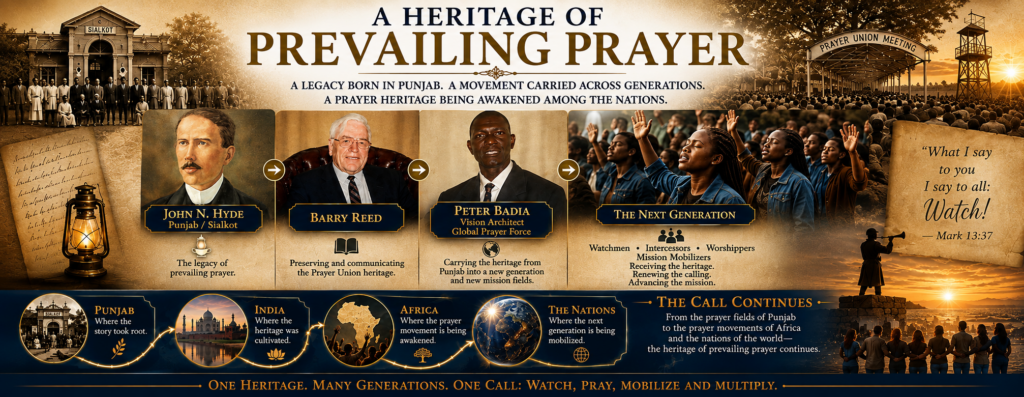
THE HERITAGE CHAIN
JOHN NELSON HYDE
A legacy of intercession
↓
PUNJAB PRAYER UNION
A legacy of united prayer
↓
SIALKOT
A context of prayer, mission and Christian witness
↓
BARRY REED
A legacy received and transmitted
↓
PETER BADIA
A present-generation steward of the Prayer Union principles
↓
THE NEXT GENERATION
A responsibility to carry it forward
FROM HERITAGE TO MOVEMENT
The chain is not intended to end with Peter Badia.
That would contradict the very principle of spiritual transmission.
The purpose of receiving the heritage is to release it.
The purpose of learning the principles is to teach them.
The purpose of establishing Prayer Unions is to multiply them.
The purpose of raising Watchmen is to send them.
Therefore the movement continues:
RECEIVE → RECOVER → PRACTICE → TEACH → MULTIPLY → SEND
HERITAGE IS RESPONSIBILITY
We do not believe heritage means simply looking backward.
Heritage asks us to look forward.
We remember so that we can recover.
We recover so that we can practice.
We practice so that we can teach.
We teach so that we can multiply.
We multiply so that the burden reaches the nations.
Therefore:
THE HERITAGE MUST BECOME A MOVEMENT.
OUR HERITAGE PRINCIPLES
From this heritage we seek to recover several enduring principles:
1. PRAYER IS MINISTRY
Prayer is not merely preparation for ministry.
Prayer itself is ministry.
2. BURDEN MUST BE CARRIED
God-given burdens require faithful intercession.
3. PRAYER MUST BE UNITED
We are stronger when we learn to seek God together.
4. WATCHMEN MUST BE RAISED
Every generation needs men and women who will stand before God on behalf of others.
5. PRAYER MUST PRODUCE OBEDIENCE
Prayer should lead us toward mission.
6. THE BURDEN MUST BE PASSED ON
No generation owns the heritage.
We are stewards of what we have received.
THE DIGITAL HERITAGE ARCHIVE
The initial PrayerUnion.org heritage page can remain simple.
Later, it can develop into a comprehensive digital archive containing:
PEOPLE
Biographies and testimonies.
PLACES
Punjab, Sialkot and other significant locations.
DOCUMENTS
Books, letters, manuscripts and historical records.
PHOTOGRAPHS
Historical images and archival material, with appropriate permissions and attribution.
AUDIO
Recorded testimonies, sermons and interviews.
VIDEO
Documentaries, interviews and teaching.
TIMELINE
A chronological history of prayer movements and Prayer Union developments.
RESEARCH
Articles, papers and historical studies.
ORAL HISTORY
Interviews with people who personally received and transmitted the Prayer Union principles.
A NOTE ON HISTORICAL INTEGRITY
The heritage archive should be built with care and accuracy.
Where a claim is historically documented, we should provide the source.
Where a story comes from oral tradition or personal testimony, we should identify it as such.
Where different historical accounts disagree, we should acknowledge the difference rather than presenting one version as unquestionable fact.
This will make PrayerUnion.org not only inspirational but also a credible resource for researchers, churches, missionaries and future generations.
THE HERITAGE CALL
We stand between generations.
Behind us are those who prayed.
Before us are nations still waiting.
And beside us is a generation that must be taught to pray.
Therefore we say:
We will remember the past.
We will recover its enduring principles.
We will practice them in our generation.
We will teach them to those who come after us.
And we will carry the burden to the nations.
FROM PUNJAB TO THE NATIONS.
FROM ONE GENERATION TO THE NEXT.
PRAY • WATCH • PREVAIL • SEND
THE BURDEN MUST NOT DIE WITH US.